
Ever snap at a coworker, then wonder why you acted that way? Or feel stressed all day, even when nothing “bad” happened? Psychology helps explain those moments by studying how people think, feel, and act. It looks at the mind, but it also tracks real behavior you can observe.
So when your emotions spike at work or your friendships get tense, psychology gives you a clearer lens. It blends natural science (like how the brain works) with social science (like how groups shape you).
Ready to see how it changes your view of everyday life?
What Psychology Really Studies Every Day
Psychology is the scientific study of mind and behavior, and it covers more than you might expect. It pays attention to what you notice, and also to what happens without your awareness. That includes thoughts, emotions, motivations, and the choices people make.
In practice, psychology asks questions like: Why do you remember some things and forget others? Why does a habit stick even when you want to quit? Why do some fears grow while others fade?
A key idea is that psychology studies both conscious and unconscious processes. For example, you might consciously decide to check your phone. At the same time, your brain might automatically seek quick comfort, attention, or relief. Those “automatic” patterns matter a lot.
Psychology also focuses on observable behavior. In other words, it doesn’t rely only on guesses about feelings. Researchers test ideas using careful methods, then compare results across people and situations.
It’s also broader than humans. Psychologists study animals too, because behavior patterns can reveal general rules about learning, stress, and survival. If you’ve ever trained a pet, you’ve already touched a basic psychology principle.
Psychology sits between biology and sociology, so it can connect body and social life. Your stress response isn’t only mental, it also involves systems in your body. Meanwhile, your stress often links to your workplace, your family role, or the way your group talks about success.
For a simple example, think about advertising. A lot of ads aim at attention, and they often use timing, color, or repeated messages. Psychology helps explain why that works. It also helps explain why your “best plan” for behavior can still lose to a strong cue.
If you want a straightforward definition, see what psychology studies.
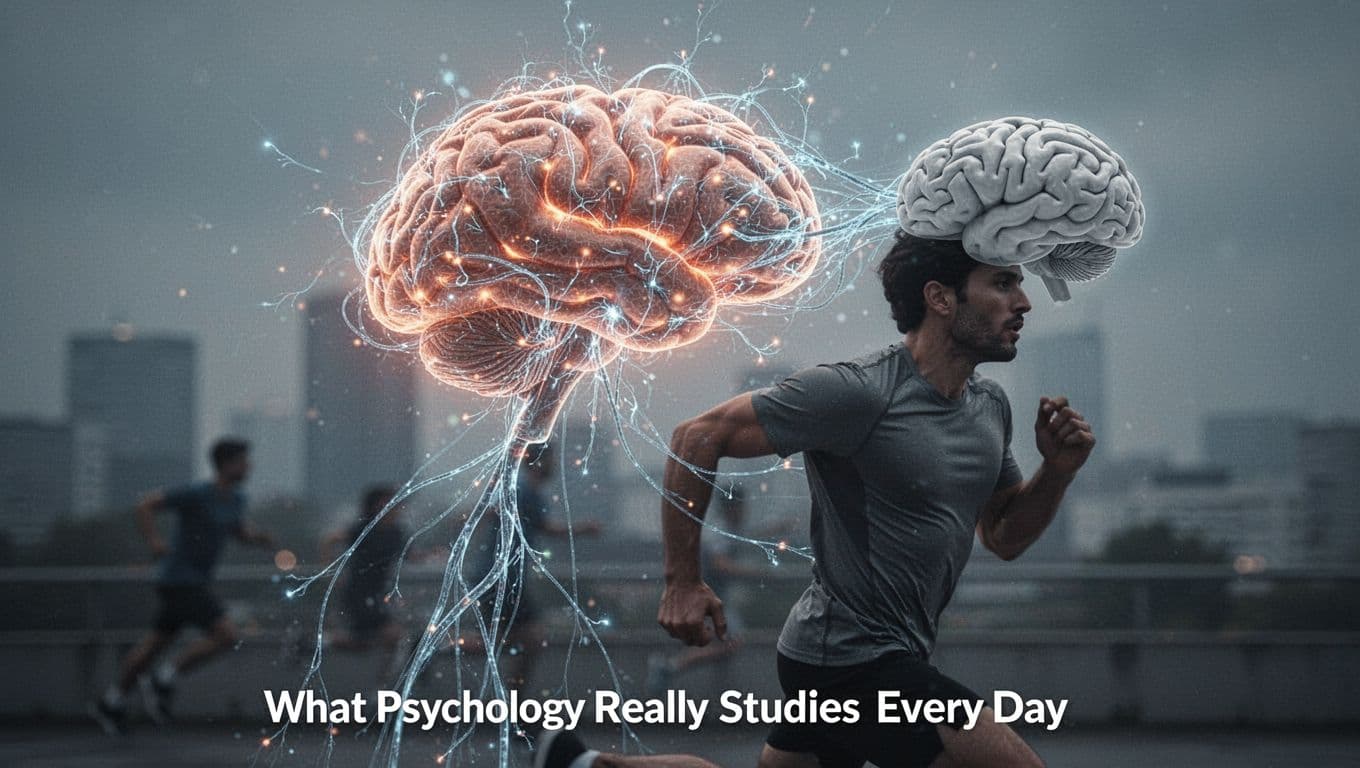
In short, psychology matters because it explains patterns you live with daily. It turns “Why did I do that?” into “There are reasons, and I can learn from them.”
Psychology’s Quick History Lesson
Psychology didn’t start as one single idea. It grew as people argued about what counts as good evidence.
In the late 1800s, early researchers began treating the mind as a topic for science. William James, writing around 1890, helped popularize the idea of psychology as the study of “mental life.” People wanted to understand how experience shapes behavior.
Then John B. Watson pushed hard for a stricter focus in 1913. He argued that psychology should stick to what you can measure. That push shaped behaviorism, where researchers studied learning and habits using experiments you could repeat.
For a long time, the field bounced between two needs. On one hand, people wanted to understand inner experience. On the other, they needed solid, measurable results.
Over time, psychology found ways to bring both together. Today, researchers use brain imaging tools to connect behavior with brain systems. They also study culture more carefully, because values and norms shape how people interpret stress, family roles, and fairness.
One fun way to picture this growth is to imagine psychology as a science that keeps adding “better tools.” Early labs relied on careful observation and basic tests. Modern labs can track brain activity, patterns in speech, and real-world behavior over weeks.
Still, the goal stayed the same. Psychology aims to explain behavior with methods that hold up under testing.
If you want a clear timeline, OpenStax’s history of psychology is a solid starting point.

History also matters for one more reason. When you know psychology changed over time, you stop treating it like a set of “always true” slogans. Instead, you see it as a field that improves its methods.
The Main Branches That Power Psychology
Psychology is large, but most of it connects back to a few main branches. Each branch zooms in on a different question, then adds its own tools and research style.

Here’s a quick map of five core branches and what they focus on:
| Branch | What it studies | Everyday example |
|---|---|---|
| Clinical | Mental health and treatment | Talk therapy for anxiety |
| Cognitive | Thinking, memory, learning | Cramming that backfires |
| Developmental | Change across life | Teen risk and identity shifts |
| Social | Influence of others and groups | Following the crowd |
| Neuroscience | Brain systems and behavior | Stress hormones affecting focus |
If you want a wider list of subfields, major branches of psychology helps you see the big picture.
Now let’s make each branch feel real.
Clinical Psychology: Fixing Mental Health Hurdles
Clinical psychology focuses on diagnosing and treating mental health issues. This branch often uses therapy to reduce suffering and help people function better.
A common example is talk therapy for anxiety. Someone might learn ways to spot worry patterns, face feared situations step-by-step, and calm their body when panic hits. Over time, that support can reduce avoidance and bring more control.
Clinical psychology also cares about safety and risk. Therapists often work with clear treatment goals, and they adjust methods based on progress.
Cognitive Psychology: Unlocking How We Think
Cognitive psychology studies how you process information. That includes memory, attention, learning, and decisions.
Think about studying for a test. If you cram the night before, you may feel “ready,” but your brain often stores details as fragile and temporary. Then exam pressure hits, and recall gets messy.
Cognitive psychology explains why. Your brain uses strategies like spacing and practice to build stronger access. It also shows how attention limits shape what you actually learn.
Developmental Psychology: Growth from Cradle to Grave
Developmental psychology studies how people change across life. It looks at the shifts from childhood to teen years, and later into adulthood and aging.
For example, teens often face bigger swings in emotion and motivation. They also take more social risks, partly because the brain and social world both shift at the same time. Developmental research helps explain why “just be mature” usually misses what’s happening.
The big point is simple. Behavior changes for reasons, and those reasons often link to age, experience, and environment.
Social Psychology: The Pull of People Around Us
Social psychology studies how other people shape your thoughts and actions. It explores influence, bias, group norms, and communication.
A clear example is following crowds. When you see others act a certain way, your brain uses them as a guide. Even if you’d make a different choice alone, group pressure can nudge you.
That doesn’t mean you’re “weak.” It means your mind is wired to adapt to social signals.
Neuroscience: Where Brain Meets Behavior
Neuroscience connects brain biology to behavior. It asks how brain structures and systems affect mood, attention, and action.
A common everyday example involves stress. When stress stays high, your body may release hormones that affect focus and sleep. Then you feel more irritable and less patient. Your “mind” and your “body” don’t separate that easily.
Neuroscience helps explain why. It supports the idea that mental states often come with physical changes.
How Psychology Boosts Work, Love, and Health
Psychology doesn’t just sit in textbooks. It shows up in your life every day, especially in places where pressure builds.
At work, teams run on trust, feedback, and coordination. When stress rises, people interpret tone more harshly and react faster. That can turn small issues into bigger ones, especially during deadlines or layoffs.
Recent trends also point to heavy needs around mental health. In the US, workplace stress and burnout remain widespread, and many people report anxiety, low sleep, and strained relationships due to work pressure. That’s why therapy access, manager training, and supportive policies matter now more than ever.
Psychology also supports work-life balance. It helps people build habits that reduce overload. It also helps leaders set norms that lower blame and raise clarity.
In relationships, psychology matters even when everything “looks fine.” Communication patterns, empathy, and conflict timing shape outcomes. For example, if you both argue while stressed, your brain might scan for threat instead of listening. Then you miss the point.
So couples often benefit from learning new skills. These can include emotion labeling, repair after fights, and clearer requests.
Health is the third big area. Stress affects sleep, appetite, and pain sensitivity. It also changes how you handle cravings and motivation. That’s why stress management isn’t just “self-care talk.” It affects daily functioning.
Psychology also connects to education and learning. When people understand how memory works, they study differently. When they use spaced practice instead of cramming, they retain more and panic less.
Finally, communities and public health programs use psychology to improve wellbeing. Support groups, coaching, and group-based interventions can reduce isolation and strengthen coping.
In 2026, psychology trends also reflect new tools and new risks. The American Psychological Association has highlighted changes that include AI supports, mental health recovery after COVID, and rising attention to whole-life wellbeing. You can see 9 trends to watch in 2026 for a high-level snapshot.
Still, it’s wise to stay grounded. AI tools can help with reminders, tracking, or quick self-checks. But human care matters when emotions feel heavy. The goal is balance: use tools to support real help, not replace it.
If you want a personal payoff, start small. Pay attention to patterns like your stress triggers and your bias in group settings. Then test small changes for one week.
Conclusion
So, what is psychology? It’s the scientific study of mind and behavior, across humans and animals. It grew through debates about evidence, then expanded through better methods, like brain research and careful experiments.
Psychology matters because its branches help explain real issues. Clinical work supports mental health care. Cognitive research helps you learn smarter. Social psychology explains how people pull on each other. Developmental research explains how change happens. Neuroscience connects brain and body.
In the fast world of 2026, one practical step can make a big difference. When you notice a strong reaction, pause and ask what pattern might be driving it. What you learn from that moment can help you choose better next time.